
Gum disease treatment eliminates infection and stabilizes the gums. For many patients, that’s enough. Scaling and root planing, improved home care, and regular maintenance visits bring the disease under control, and the teeth stay in place.
For some patients, the gums are only half the problem. The other half is what’s happening above the gum line. Teeth that have shifted, worn down, or been restored poorly can stress the periodontal tissues in ways no amount of cleaning can fix. That’s where a prosthodontist’s perspective changes the treatment plan.
Dr. Roham Rafat at Valley Dental Health is one of the few specialists in Maryland with training in both periodontics and prosthodontics. He treats gum disease and understands how the bite, the restorations, and the teeth themselves interact with the gums. For patients in Hunt Valley, Cockeysville, and the surrounding Baltimore area who have been treated for gum disease without lasting success. That dual perspective can answer a question the cleaning alone can’t: is something else driving the disease?
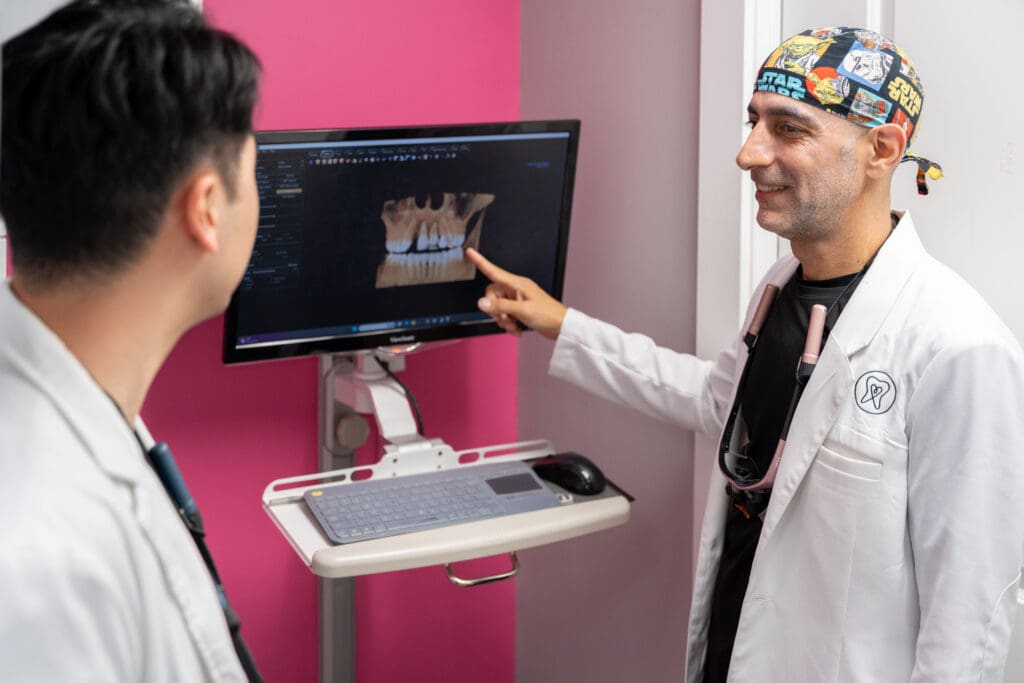
The Two-Way Street Between Gums and Restorations
The relationship between periodontal health and dental restorations runs in both directions. A successful restoration depends on healthy gums. Periodontal health depends on restorations that function correctly.
That means if a crown sits too high or too low, it can create a ledge where bacteria collect. If a filling has a rough margin, plaque accumulates there. If the bite is uneven, some teeth take more force than others, and the periodontal ligament that holds those teeth in place can become inflamed. Over time, that inflammation can contribute to bone loss and gum recession.
Dr. Rafat’s prosthodontic training means he looks at every tooth in the mouth and asks, “Is this tooth being asked to do something it wasn’t designed to do?” A tooth with a perfectly healthy root can still fail if the restoration on top creates a mechanical problem.
When Gum Treatment Alone Doesn’t Hold
Some patients go through periodontal treatment and see improvement, only to have the disease return months later. Others see their gums stabilize but notice that their teeth are still shifting or their bite feels different. These are signs that the periodontal treatment addressed the infection but not the underlying cause.
Occlusal trauma is one of the most common culprits. When teeth don’t come together evenly, some take more force than others. That excessive force can widen the periodontal ligament space, create mobility, and contribute to bone loss. Scaling and root planing won’t fix this. The bite needs to be adjusted or the restorations redesigned.
Failing restorations are another factor. An old crown with an open margin, a worn-down filling, or a bridge that no longer fits properly can trap bacteria and put stress on the teeth that support it. The gums around those teeth may stay inflamed no matter how often they’re cleaned.
Missing teeth change the way the remaining teeth function. When a tooth is lost, the neighboring teeth can tip into the gap. The opposing tooth can over-erupt because there’s nothing stopping it. The bite becomes unbalanced, and the gums around the remaining teeth take the stress. Periodontal treatment alone can’t correct this. The missing tooth needs to be replaced, and the bite needs to be restored.
Dr. Rafat evaluates all of these factors when a patient comes to him with gum disease that isn’t responding to treatment. His periodontal training identifies the infection and the tissue damage. His prosthodontic training identifies the mechanical and functional problems that are contributing to it.
What a Prosthodontic Evaluation Adds
When Dr. Rafat sees a patient with recurrent or persistent gum disease, the evaluation goes beyond pocket depths and X-rays, such as:
- Bite Analysis: He looks at how the teeth come together, how the jaw joints function, and whether there are signs of grinding or clenching. An unbalanced bite puts stress on the periodontal tissues, and that stress can accelerate bone loss.
- Restoration Review: Every crown, filling, bridge, and implant in the mouth gets evaluated. Are the margins sealed? Is the contour correct? Does the restoration match the opposing tooth? A restoration that looked fine five years ago may be creating problems now.
- Tooth Position and Mobility: Teeth that have shifted or become mobile need assessment. Is the mobility caused by bone loss, or by excessive force on a tooth with adequate bone support? The answer determines the treatment.
- Implant Health: For patients with dental implants, Dr. Rafat checks the bone level around the implant, the health of the gum tissue, and how the implant restoration functions in the bite. Peri-implantitis, the implant version of gum disease, is often driven by the same mechanical factors that affect natural teeth.
The Treatment Plan That Addresses Both
When Dr. Rafat identifies a prosthodontic component to a periodontal problem, the treatment plan changes. Periodontal treatment still comes first because infection must be controlled before any restorative work. But the plan doesn’t stop there:
- Bite adjustment may be needed to balance the forces on the teeth. This can be as simple as reshaping a few high spots on the enamel, or as complex as redesigning multiple restorations.
- Restoration replacement may be necessary if old crowns or fillings are contributing to the problem. Dr. Rafat’s prosthodontic training means he can design restorations that fit the bite, seal properly, and support gum health.
- Tooth replacement may be needed for missing teeth that are causing the remaining teeth to shift and the bite to collapse. Dental implants, bridges, or dentures can restore function and take stress off the periodontal tissues.
Periodontal maintenance continues throughout because the patient’s susceptibility to gum disease doesn’t go away. The difference is that maintenance now protects a stable, functional mouth rather than one that’s fighting itself.
Why This Matters for Patients in Hunt Valley
Most periodontists treat gums. Most prosthodontists design restorations. Few clinicians are trained in both. Dr. Rafat’s dual training means patients at Valley Dental Health don’t have to coordinate between a gum specialist and a restorative dentist who may not communicate. The evaluation, the treatment, and the long-term maintenance all happen in one dental office in Cockeysville.
If you’ve been treated for gum disease but still see bleeding, recession, or shifting teeth, the problem may not be the treatment. The treatment may have addressed the infection but not the mechanical factors driving it. A consultation with Dr. Rafat can identify both.
Call Valley Dental Health at 443-733-6613, or request an appointment online. The office serves patients from Hunt Valley, Timonium, Sparks, Phoenix, and Jacksonville.