
A smile makeover changes how your teeth look. Full-mouth reconstruction changes how they work. That distinction matters more than most patients realize. It’s the first thing Dr. Roham Rafat explains when someone comes to Valley Dental Health asking about rebuilding their mouth.
Patients in Hunt Valley, Cockeysville, and the surrounding Baltimore County communities often arrive with the same story. They’ve been told they need “a lot of work.” They’ve seen one dentist for a crown, another for a missing tooth, and maybe a specialist for their gums. Nobody has looked at the whole picture. That’s what full-mouth reconstruction does. It treats the mouth as a system, not a collection of problems.
Dr. Rafat is a periodontist and prosthodontist at Valley Dental Health. He’s one of only a few dual specialists in Maryland, which means he can treat the gums and bone that support your teeth and design the restorations that sit on top of them. For patients facing complex dental problems, that combination changes the conversation from “what can we fix?” to “what should we save, and what should we replace?”
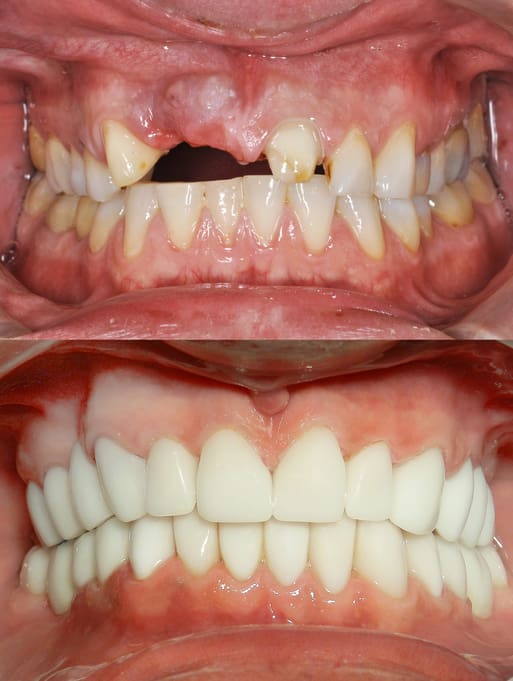
The Difference Between a Makeover and a Reconstruction
A smile makeover is cosmetic. It focuses on how teeth look: their color, shape, and alignment. Veneers, whitening, and bonding fall into this category. These treatments can produce beautiful results, and they have their place, but they assume the foundation underneath is stable.
Full-mouth reconstruction starts with the foundation. Before any cosmetic work begins, Dr. Rafat evaluates the gums, the bone that holds the teeth, the bite, and the jaw joints. If gum disease is active, it gets treated first. If bone has been lost, we rebuild it. If teeth are failing because the bite is unbalanced, we correct the bite before placing new restorations.
This order isn’t optional. Placing crowns or veneers on teeth supported by diseased gums is like painting a house with a cracked foundation. It might look good for a while, but it won’t last. Dr. Rafat’s periodontal training means he sees the foundation first, and his prosthodontic training means he knows how to build restorations that will last for years.
What Dr. Rafat Looks For Before Deciding
The first appointment for a full-mouth reconstruction consultation at Valley Dental Health isn’t a quick look in the mouth. It’s a comprehensive evaluation that includes digital imaging, a periodontal screening, a bite analysis, and an examination of the jaw joints. Dr. Rafat needs to understand not just what’s damaged, but why.
- Teeth That Can Be Saved: Some teeth look bad but have a solid root and healthy bone support. A tooth with a large cavity or a failed old crown might still be restorable with a new crown or an onlay. Dr. Rafat’s prosthodontic training means he can assess whether a tooth can be rebuilt to handle the forces it will face, not just patched.
- Teeth That Need To Be Replaced: Some teeth are beyond saving. Severe decay that reaches below the gum line, a root fracture, or advanced bone loss around a tooth can make extraction the better choice. This is where Dr. Rafat’s periodontal background matters. He can evaluate the bone and gum tissue around each tooth and determine whether it can support a restoration long-term.
- Teeth That Should Be Left Alone: Not every tooth needs work. Part of the planning process is identifying which teeth are healthy and stable and should be kept exactly as they are. Full-mouth reconstruction isn’t about doing as much treatment as possible. It’s about doing the right treatment for each tooth.
- The Bite: This is the piece most patients don’t think about. If your bite is off, new restorations will fail prematurely. Dr. Rafat evaluates how your teeth come together, how your jaw joints function, and whether signs of grinding or clenching need to be addressed before reconstruction begins.
Why the Sequence Matters More Than the Procedures
Full-mouth reconstruction at Valley Dental Health follows a phased approach. The phases aren’t arbitrary. They follow the biology of healing and the mechanics of how teeth and implants work together.
- Phase One: Treat Active Disease. Gum disease, infection, and decay get addressed first. Dr. Rafat may perform scaling and root planing, laser periodontal therapy, or other treatments to restore gum health. If teeth need to come out, they’re removed during this phase. The goal is to eliminate active infection before any rebuilding begins.
- Phase Two: Rebuild The Foundation. If bone has been lost, bone grafting may be needed. If teeth are missing, implant placement happens here. Dr. Rafat performs these surgical procedures himself, which means there’s no handoff to another office and no waiting for records to be transferred.
- Phase Three: Restore Function & Appearance. Once the foundation is stable and healing is complete, the restorative work begins. Crowns, bridges, dentures, or implant-supported restorations get designed and placed. Dr. Rafat’s prosthodontic training means he considers how each restoration fits with the others, how the bite will function, and how the final result will look.
- Phase Four: Cosmetic Finishing. For patients who want to address aesthetics, this is when veneers, whitening, or final adjustments happen. Cosmetic work comes last because it should enhance a healthy, functional result, not compensate for a compromised one.
The Questions Patients Should Ask
If you’re considering full-mouth reconstruction, Dr. Rafat recommends asking a few specific questions at your consultation:
- Who is planning the entire treatment? If the answer involves multiple offices and multiple providers who don’t share records, you’re likely to get fragmented care. At Valley Dental Health, Dr. Rafat plans the surgical and restorative phases together because he’s trained in both.
- What happens if a tooth fails during treatment? Full-mouth reconstruction often involves borderline teeth. Some may fail despite the best planning. Dr. Rafat discusses contingency plans before treatment begins, so patients understand what happens if a tooth that was supposed to be saved doesn’t hold up.
- How long will this take? Full-mouth reconstruction isn’t a single appointment. Healing from extractions, grafting, or implant placement takes months. Dr. Rafat gives patients a realistic timeline based on their specific plan, not a generic estimate.
- What does this cost, and how do we phase it? Valley Dental Health offers CareCredit financing and works with patients to phase treatment over time when needed. The practice also offers a KLEER membership program for patients without insurance.
Why Patients in Hunt Valley Come to Valley Dental Health
Full-mouth reconstruction is complex. It requires a clinician who can see the whole picture, plan the sequence, and execute both the surgical and restorative phases. Dr. Rafat’s dual training in periodontics and prosthodontics means patients in Hunt Valley, Timonium, Sparks, Phoenix, and Jacksonville don’t have to coordinate between multiple specialists. The evaluation, the surgery, and the final restorations all happen at the Cockeysville office on York Road.
If you’ve been told you need extensive dental work, or if you’ve been bounced between providers who each want to treat a different piece of the problem, a full-mouth reconstruction consultation with Dr. Rafat can give you a clear plan. Call Valley Dental Health at 443-733-6613, or request an appointment online.